THE MANTRA PROJECT

Driving Sustainable and Innovative Manufacturing through Green, Digital and Social Transformation for SMEs

Driving Sustainable and Innovative Manufacturing

The manufacturing industry – a sector mainly built on SMEs – is a strong asset for the European economy and an important driver of employment and prosperity. However, it is also energy intensive, responsible for one fifth of EU greenhouse gas emissions.

MANTRA is developing a training and capacity building programme to provide manufacturing SMEs with the financial and technical support needed to become more sustainable, competitive and resilient.

MANTRA will directly support a group of 50 manufacturing SMEs in the form of a €50,000 financial support, with a tailored process in which they learn and unlock their digital and technological potential within a sustainable business model, that ensures more resource-efficient and circular processes and infrastructures.

MANTRA targets EU manufacturing SMEs willing to uptake advanced technologies and social innovation in 6 focal sectors

Machinery

Food

Textile

Plastics

Ceramics

Metals

Latest News & Events

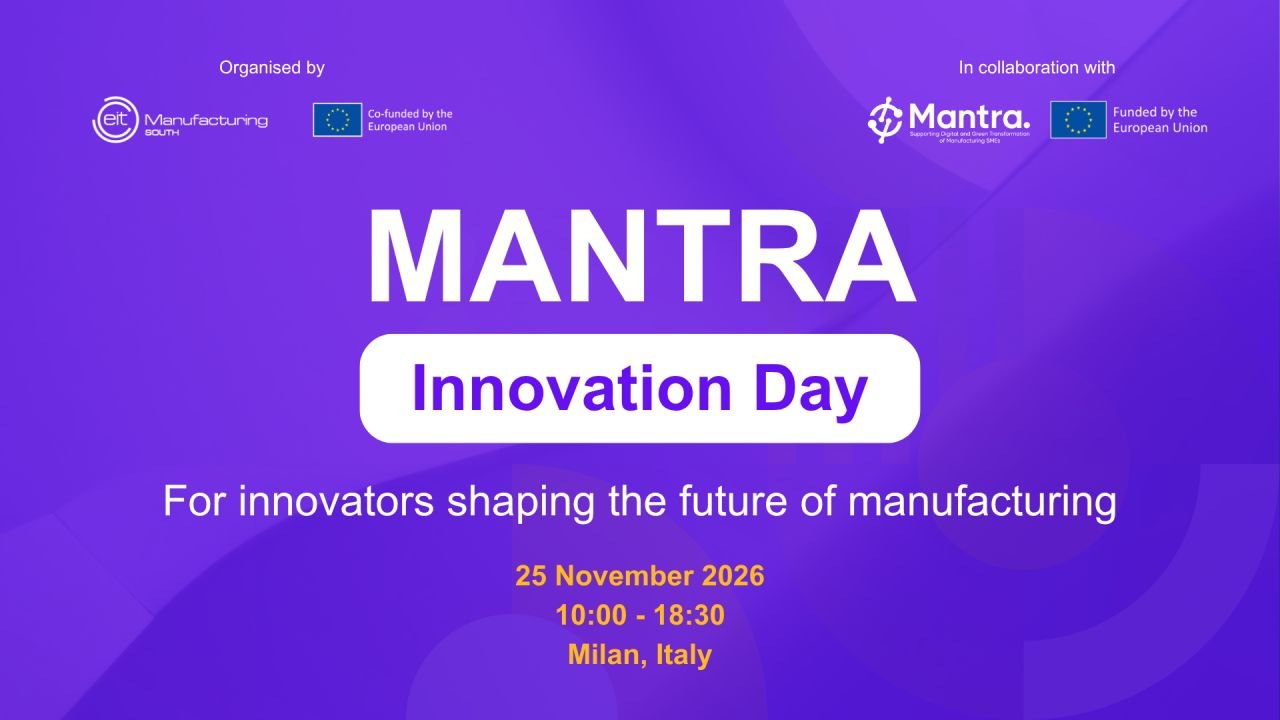
MANTRA Innovation Day 2026

25 November | 10:00 – 18:30 Where manufacturing’s future gets built, one connection at a time. MANTRA brings its community together for a full day of innovation, investment and the people powering both. The day is structured in two parts, each designed to highlight innovation, collaboration, and the opportunities emerging from the European landscape, connecting people, ideas, and market‑ready solutions. The morning session is an agile training focused on European opportunities, covering key topics across funding, partnerships, and innovation pathways, and offering practical tips for navigating calls and strategic suggestions to perform effectively. The afternoon session is Access2Tech, our flagship event, with a special focus on MANTRA companies. Access2Tech is where corporates meet the startups and SMEs shaping smart, human-centric manufacturing. Now in its 4th edition, the event brings together 15 corporates/SMEs and 15 hand-picked startups for real, business-focused conversations. The afternoon is divided into three segments: Pitch sessions where startups present technologies and solutions to improve industrial and manufacturing processes B2B session among participants based on a pre-scheduled agenda Final networking session to maximise the networking opportunities Registering for the event does not automatically guarantee a place in the B2B session. To keep meetings relevant and well matched, the organisers reserve the right to confirm B2B session participation. Selected participants will receive a confirmation email with further details on the day, including practical information, the meeting agenda and next steps. No crowded floor to navigate. No generic pitches. Just pre-matched meetings with the people who matter to your growth. What to expect A curated selection of startups and SMEs at the forefront of manufacturing innovation Pre-matched B2B meetings, built around your specific interests Direct access to corporate scouting teams and R&D partners Insight into where manufacturing technology is heading next The programme is currently being updated and may be further enriched with additional in‑depth discussion and networking moments, dedicated to innovation and manufacturing topics.   Register here: MANTRA Innovation Day Tickets, Wednesday 25 November  •  10 AM – 6:30 PM | Eventbrite

The Cyber Resilience Act: Practical Steps and Resources for Manufacturing SMEs — An interview with a MANTRA Expert

As digital products become increasingly connected, cybersecurity is no longer optional, it is a business necessity. The Cyber Resilience Act (CRA), Regulation (EU) 2024/2847, establishes common cybersecurity requirements for products with digital elements across the European Union. By introducing security-by-design principles, vulnerability management obligations, and greater transparency for users, the CRA aims to strengthen the resilience of the EU’s digital ecosystem. While the Regulation will become fully applicable from 11 December 2027, key obligations start earlier, making it essential for manufacturing SMEs to begin preparing now. To help businesses better understand the new requirements, MANTRA has gathered insights from cybersecurity experts across Europe. Acknowledgements: MANTRA would like to thank SECURE – Cyber Resilience for SMEs for contributing their expertise and practical insights to this article. Their perspectives help clarify the implications of the Cyber Resilience Act for manufacturing SMEs and provide concrete guidance on how organisations can begin their compliance journey  The Cyber Resilience Act is reshaping the way digital products are designed and managed. What should manufacturing SMEs know about the regulation, and why is it important to start preparing now? The key message is that the Cyber Resilience Act turns cybersecurity from a voluntary good practice into a legal product requirement. The CRA applies to a wide range of hardware and software made available on the European market. Manufacturing SMEs should therefore not assume that it concerns only software companies. Connected machinery, smart sensors, control systems and other products containing digital components may also fall within its scope. Manufacturers will need to manage cybersecurity throughout the product’s lifecycle. In practice, this means assessing cyber risks, designing products securely, controlling vulnerabilities in components and software libraries, providing security updates, handling vulnerability reports and maintaining the necessary technical documentation. Before placing a product on the market, manufacturers must also demonstrate conformity with the CRA and apply the CE marking. The applicable assessment procedure will depend on the type and risk category of the product. Preparation is now urgent. From 11 September 2026, manufacturers must report actively exploited vulnerabilities and serious security incidents. An initial warning may be required within 24 hours and a more detailed notification within 72 hours. The main product-security and conformity obligations will apply from 11 December 2027. European Commission – CRA reporting obligations For many SMEs, compliance will require changes to product development, supplier agreements, update mechanisms, documentation and incident-response processes. These changes cannot realistically be introduced just before the deadline. Companies should start by identifying which products are covered, clarifying their role in the supply chain, assigning internal responsibility and comparing their current practices with the CRA requirements. The CRA should not be approached as a one-off certification exercise. It requires manufacturers to remain responsible for the cybersecurity of their products after they have been sold. Starting early reduces compliance costs, limits last-minute redesigns and helps ensure continued access to the European market. What are the biggest challenges or misconceptions that manufacturing SMEs face when approaching CRA compliance? The biggest challenge is that many manufacturing SMEs still view the CRA as an IT or administrative compliance exercise. In reality, it affects product design, engineering, procurement, after-sales support and management responsibility. A first misconception is: “We manufacture machines, not software.” The CRA covers hardware and software products with digital elements, including connected machinery, sensors, controllers, embedded software and components sold separately. A traditional manufacturer may therefore fall within scope even if software is only one part of its product. A second misconception is that good organisational cybersecurity—or compliance with NIS2 or ISO 27001—automatically means CRA compliance. These measures can help, but the CRA focuses specifically on the security of the product. The manufacturer must assess product-related cyber risks and demonstrate how these risks are addressed. A third challenge is supply-chain visibility. Manufacturers often depend on third-party software, chips, libraries and connected services without having sufficient information about their vulnerabilities or update policies. Outsourcing a component does not remove the manufacturer’s responsibility for the security of the final product. Another common mistake is treating compliance as a one-off test before placing the product on the market. The CRA requires security throughout the product lifecycle. Manufacturers must be able to receive vulnerability reports, provide security updates, manage incidents and support the product for the declared support period. There is also uncertainty about conformity assessment. Not every product automatically requires expensive third-party certification; the applicable procedure depends on the product’s classification and risk profile. However, every manufacturer will need adequate risk assessments, technical documentation and evidence of compliance. Finally, many SMEs are waiting for all standards and guidance to be finalised. That is risky. They can already take “no-regret” steps: identify products in scope, map digital components and suppliers, assign responsibilities, introduce secure development practices and establish vulnerability and update processes. These foundations take time and will be necessary regardless of the final technical standards. Many SMEs believe compliance is expensive and complex. What free or accessible tools, training resources, standards, or support initiatives already exist to help them? The cost concern is understandable, but SMEs do not need to begin with an expensive compliance platform or consultancy project. A growing range of free and accessible resources is already available. In Belgium, the CCB provides CRA information in Dutch, French and German. Through the EU-funded SECURE project, the CCB has also developed practical resources for SMEs: a beginner-friendly “CRA 101” guide, technical guidance on the essential cybersecurity requirements, a methodological compliance-assessment framework containing checklists, examples and references to useful tools, and a CRA Maturity Score tool to help mSMEs assess where they currently stand in terms of compliance and what gaps need closing. Additionally, Trainings are freely available and being produced on a rolling basis, and through SECURE, European mSMEs can receive funding to support their CRA compliance. At European level, the European Commission provides FAQs and practical guidance explaining issues such as product scope, risk assessment, support periods, reporting and substantial modifications. These should be the starting point for interpreting the regulation. ENISA offers particularly useful free resources, for example: The Secure by Design and Default Playbook translates product-security principles into concrete engineering actions and examples of supporting evidence. ENISA also provides instructions and FAQs for the CRA Single Reporting Platform, which manufacturers will use to report actively exploited vulnerabilities and serious incidents. Several EU-funded initiatives provide or are developing open-source tools, training, templates and compliance-assessment support. These can help with subjects such as product-risk assessments, technical documentation, software bills of materials, vulnerability management and security testing. SMEs should check the project portals regularly, as available tools, training sessions and funding opportunities evolve. Existing standards such as IEC 62443 for industrial systems and ETSI EN 303 645 for consumer IoT can also provide useful technical building blocks. However, using a standard does not automatically prove CRA compliance. Only harmonised standards formally recognised under the CRA can provide a presumption of conformity for the requirements they cover. The CCB’s CyberFundamentals framework and Safeonweb@work resources can help SMEs strengthen their general organisational cybersecurity. They are valuable foundations, but they should not be confused with a complete CRA product-compliance assessment. Our advice is therefore to use the free resources first to determine scope, assess gaps and create an implementation roadmap. Specialist support can then be reserved for areas where it adds real value, such as product classification, conformity assessment or specialised security testing.  If you could recommend just three practical actions that an SME should take today to begin its CRA journey, what would they be? 1.Identify your products in scope and assign ownership Create a simple register of the products and versions you place on the EU market, including their software, connected functions and third-party components. Record your role—manufacturer, importer or distributor—and make an initial assessment of the likely product classification and conformity route. Appoint one responsible CRA coordinator, supported by engineering, quality, procurement and legal staff. 2. Perform a gap assessment on one priority product Select a representative or high-risk product and compare its current design and lifecycle processes with the CRA’s essential cybersecurity requirements. Map its architecture, interfaces, software dependencies, suppliers, update mechanisms and existing security measures. Document the risks, gaps, actions and available evidence. Starting with one product creates a repeatable method that can later be applied across the portfolio. 3. Make vulnerability handling and reporting operational Establish a clear contact point for vulnerability reports and define how the company will monitor, assess, correct and communicate vulnerabilities. Include supplier escalation, security updates, customer communication and regulatory reporting. Test the process using a realistic scenario: could the company identify affected products, take decisions and submit an early warning within 24 hours? This third action is particularly urgent because the CRA reporting obligations apply from 11 September 2026, ahead of the full application of the remaining requirements in December 2027. These actions should produce three tangible results: a product register with clear ownership, a prioritised compliance roadmap and a tested vulnerability-response process. That is a much stronger starting point than collecting legal documents without changing how products are designed and supported. Contributor: Yves Streel SECURE Senior Project Manager NCC-BE department at the Centre for Cybersecurity Belgium

Strengthening Europe’s Manufacturing Ecosystem: MANTRA and GreenMantis Supporting SMEs on the Path to the Twin Transition

Europe’s manufacturing SMEs are facing unprecedented challenges. Rising energy costs, increasing sustainability requirements, rapid technological change, and global competition are reshaping the industrial landscape. To remain competitive, SMEs need more than isolated solutions. They need access to a strong innovation ecosystem that supports their transformation from multiple perspectives. This is where European collaborative initiatives such as MANTRA and GreenMantis play an important role. By addressing different aspects of industrial transformation, they contribute to a broader European ecosystem that helps manufacturing SMEs embrace the twin transition towards a more digital, sustainable, and resilient future. This is a collaborative article between two projects, MANTRA and GreenMantis, as part of their ongoing synergy (October 2026).  MANTRA: Empowering SMEs through Digital, Circular and Social Innovation MANTRA supports manufacturing SMEs in accelerating their transformation by combining advanced digital technologies, circular economy principles, and social innovation. The project is specifically designed for traditional manufacturing SMEs with low levels of technology uptake that are seeking to modernise their operations, improve sustainability, and strengthen their long-term competitiveness. Focusing on six manufacturing sectors, namely machinery, food, textiles, plastics, ceramics, and metals, MANTRA connects SMEs with technology providers, innovation experts, and business support organisations capable of guiding them through their transformation journey. The project promotes the adoption of a broad range of advanced technologies, including artificial intelligence, robotics, the Internet of Things (IoT), big data, cloud computing, augmente and virtual reality, blockchain, advanced materials, photonics, nanotechnology, and advanced manufacturing technologies, helping companies identify the solutions that best fitntheir needs. At the heart of the project is a tailored support pathway that accompanies SMEs through four key stages: assessment, matchmaking, advisory services, and implementation support. Through this process, businesses receive specialised guidance on technology adoption, technology transfer, proof-of-concept development, innovation roadmapping, design management, investment readiness, intellectual property management, lean manufacturing, and market expansion strategies. However, MANTRA goes beyond digital innovation. The project recognises that the twin transition requires manufacturers to rethink how value is created, delivered, and sustained. Through dedicated advisory services, SMEs are supported in developing circular business models, integrating social innovation practices, and strengthening their environmental performance. Companies can benefit from sustainability-focused services such as energy assessments, greenhouse gas (GHG) emission calculations, Life Cycle Assessment (LCA), Social Life Cycle Assessment (sLCA), and Life Cycle Costing (LCC), enabling them to better understand and reduce their environmental impact while improving operational efficiency. Collaboration is a fundamental pillar of the MANTRA approach. By fostering cooperation between manufacturers, technology providers, researchers, and innovation organisations, the project helps SMEs access expertise, knowledge, and resources that would otherwise be difficult to obtain. This collaborative ecosystem enables businesses to learn from one another, adopt innovative solutions more effectively, and accelerate their transition towards more sustainable and resilient business models. To support the practical implementation of innovation projects, MANTRA also provides financial support of up to €50,000 per SME. This funding can be used for activities such as feasibility studies, prototyping, pilot testing, demonstration activities, specialised consultancy services, coaching, access to testing facilities, and the deployment of new technological solutions. By combining advisory support with direct financial assistance, MANTRA helps SMEs transform strategic ambitions into tangible results. GreenMantis: Accelerating the Green Industrial Transition Complementing these efforts, GreenMantis focuses on enabling European SMEs to adopt and scale advanced net-zero technologies. By bringing together six leading European clusters across the manufacturing and energy value chains, GreenMantis creates opportunities for SMEs to develop innovative solutions in areas such as electricity grid technologies, energy system-related energy efficiency, and transformative industrial technologies for decarbonisation: Electricity grid technologies are energy network technologies that can automatically monitor energy flows and adjust to changes in energy supply and demand. These technologies can offer users better control over their energy use and losses, enabling more effective management throughout the day and improving the resilience of the overall infrastructure. Energy system-related energy efficiency technologies are designed to reduce the amount of energy required to operate industrial processes and enable more efficient use of energy. Transformative industrial technologies leading to decarbonisation are innovative solutions designed to reduce carbon emissions from industrial processes through carbon avoidance. Their aim is to transform traditional manufacturing processes by making them more efficient. To achieve its objectives, GreenMantis has launched an innovation support scheme providing financial support for collaborative projects developing net-zero solutions. In addition, SMEs can benefit from training and internationalisation services designed to strengthen their skills, expand market opportunities, and enhance their long-term sustainability. The first Open Call was open from March to June 2026. Selected projects received up to €100,000 in equity-free funding to develop innovative energy efficiency solutions and adopt new net-zero technologies for the green transition of European industry. To participate, manufacturing SMEs had to partner with energy SMEs and form a consortium to both provide and adopt net-zero technologies. Following the success of the first Open Call, GreenMantis is planning to launch a second Open Call in the first half of 2027 to fund innovative projects at Technology Readiness Levels (TRLs) 6-8 for a duration of nine months. Similarly to the first Open Call, each project will require the creation of a consortium of European SMEs and will receive up to €100,000 in funding. The activities to be funded will be related to the development of new products or services, including technology development and prototyping (TRL 6–8), pilot testing and validation in operational environments, demonstration activities, integration of net-zero technologies into manufacturing processes, and business process innovation directly linked to technological adoption. These activities will have to address at least one of the three GreenMantis objectives: Electricity Grid Technologies Energy System-Related Energy Efficiency Technologies Transformative Industrial Technologies Leading to Decarbonisation Beyond project development, GreenMantis’s support for the green transition of European industry will also focus on business process innovation within manufacturing SMEs. By enabling the integration of new organisational methods, operational workflows, and management practices through advanced technologies, SMEs can optimise resource allocation, reduce operational risks, and improve decision-making. These improvements can contribute to greater energy efficiency within manufacturing companies. Furthermore, beneficiaries of the innovation support scheme will also participate in training activities on net-zero technologies for SMEs, an in-person matchmaking event, and an international mission to Canada or Japan. By joining GreenMantis, beneficiary SMEs will have the opportunity to take part in a comprehensive programme that not only enables them to develop new products, services, and processes, but also to connect with new partners, engage with relevant stakeholders, and expand their business networks. GreenMantis therefore provides a concrete opportunity for SMEs to grow their businesses while contributing to the decarbonisation of European industry. Building a Stronger Innovation Ecosystem for European Manufacturing The challenges facing manufacturing SMEs cannot be addressed by a single initiative. Digitalisation, circularity, social sustainability, energy efficiency, and decarbonisation are deeply interconnected. Projects like MANTRA and GreenMantis demonstrate the value of European collaboration in building an innovation ecosystem where complementary initiatives work together to support SMEs throughout their transformation journeys. While MANTRA helps companies adopt advanced technologies, develop circular business models, improve sustainability performance, and strengthen organisational resilience, GreenMantis supports the deployment of innovative net-zero solutions that accelerate industrial decarbonisation. Together, these initiatives connect businesses with expertise, technologies, funding opportunities, training, and international networks, creating the conditions for more competitive and future-ready manufacturing ecosystems across Europe. As Europe continues to advance towards its industrial and climate ambitions, fostering collaboration between initiatives such as MANTRA and GreenMantis will be essential to ensure that manufacturing SMEs have the knowledge, resources, partnerships, and innovation capacity needed to successfully navigate the twin transition and contribute to a more sustainable future for European industry This article was written by Angelica Marsico, Communication Manager at EIT Manufacturing South and Luca Tarantino, Research, Innovation and Sustainability Officer at Consindustria Emilia.

Benefits the MANTRA community can experience

The platform will serve as the largest EU network of digitalisation players, dedicated to supporting EU manufacturing SMEs.

The MANTRA platform will serve as a one-stop shop, offering a wide range of services, tools, and information tailored for SMEs to benefit from in the transformation journey.

Financial support

Networking

Open webinars

Services

Are you interested in the transformation of Manufacturing SMEs?

SECPhO is a cluster based on Spain that brings together more than 180 organisations that promote technological innovation through deep tech in all sectors of our economy. They contribute to the assessment and advisory services for SME’s, including due diligence assessments, matchmaking non-tech SMEs with tech SMEs, co-creation labs, and tailored, value-added advisory services.

Rina-C is a global network specializing in energy transition, ESG, and digitalisation, based in Italy. They are responsible for providing assessment and advisory services to the selected SMEs undergoing digital and technological transformation. This includes due diligence assessments, matchmaking tech-savvy and traditional SMEs, share best practices in co-creation labs, and offering tailored solutions and recommendations for practical implementation as part of the advisory services.

Babele is a social enterprise based in Romania, that acts as a catalyst for systemic innovation, uniting a global network of universities, corporations, NGOs, and social entrepreneurs to co-create impactful solutions to address global issues such as climate change and poverty, while fostering resilience in the face of its effects. They are responsible for developing, building, and managing the digital platform for SME recruitment, overseeing the capacity-building and support program, and connecting innovation communities, EU networks, and SME support initiatives. The platform will function as a hub for knowledge exchange and a community of practice.

Greenovate! Europe is a not-for-profit network of organisations dedicated to sustainable innovation. It develops sustainability projects and provides innovation support to researchers, companies and policymakers. The project partner based in Belgium, is responsible for the communication and dissemination activities of the MANTRA project. Their goal is to maximize the project’s impact by raising awareness, building a stakeholder community, and sharing open project results in a way that ensures they are actionable and exploitable by stakeholders.

INES TEC is a research & development institute located on the campus of the Faculty of Engineering of the University of Porto, located in Portugal. They oversee the role of identifying the needs and barriers of SMEs to create the most favorable capacity-building support services. They will connect European specialised business support structures, networks, and organizations to build-up an innovative value-added support ecosystem for SMEs.

EIT Manufacturing is a public-private partnership located in Italy, co-funded by the European Union and established in 2019 that connects manufacturing players by promoting talent and entrepreneurship to accelerate sustainable innovation in Europe. They provide coaching programs and capacity-building support to enhance the competitiveness and innovation of SMEs. Building on the SME Alliance projects and EITM initiatives, they oversee the SME ecosystem, facilitating the exchange of best practices, and enable that traditional SMEs gain from dedicated peer-learning activities, learning directly from leaders in their sector.

EIT Manufacturing is a public-private partnership located in Italy, co-funded by the European Union and established in 2019 that connects manufacturing players by promoting talent and entrepreneurship to accelerate sustainable innovation in Europe.
They provide coaching programs and capacity-building support to enhance the competitiveness and innovation of SMEs. Building on the SME Alliance projects and EITM initiatives, they oversee the SME ecosystem, facilitating the exchange of best practices, and enable that traditional SMEs gain from dedicated peer-learning activities, learning directly from leaders in their sector.

Cetim is a technological accelerator dedicated to industrial transformation. It brings the best of research to French industries and offers a comprehensive solution combining consulting and engineering services. They contribute to the assessment and advisory services for SME’s, including due diligence assessments, matchmaking non-tech SMEs with tech SMEs, co-creation labs, and tailored, value-added advisory services.

Zabala Innovation is an international consultancy firm specialising in consultancy services for both R&D and Innovation management, based in Spain. As project coordinators for MANTRA, Zabala ensures smooth project management and defines the criteria to select and prioritise the manufacturing SME projects that will be funded through the project to unlock their digital and technological potential and build sustainable business models.