Europe’s manufacturing SMEs are facing unprecedented challenges. Rising energy costs, increasing sustainability requirements, rapid technological change, and global competition are reshaping the industrial landscape. To remain competitive, SMEs need more than isolated solutions. They need access to a strong innovation ecosystem that supports their transformation from multiple perspectives.
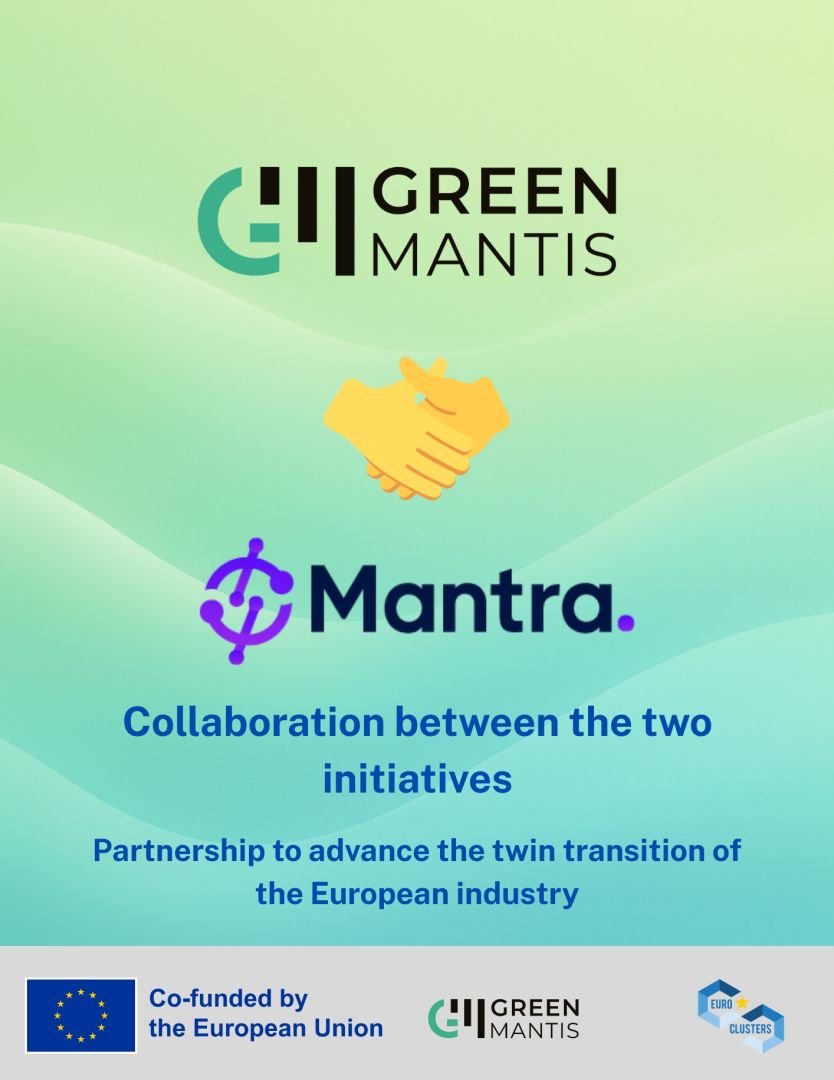
This is where European collaborative initiatives such as MANTRA and GreenMantis play an important role. By addressing different aspects of industrial transformation, they contribute to a broader European ecosystem that helps manufacturing SMEs embrace the twin transition towards a more digital, sustainable, and resilient future.
This is a collaborative article between two projects, MANTRA and GreenMantis, as part of their ongoing synergy (October 2026).
MANTRA: Empowering SMEs through Digital, Circular and Social Innovation
MANTRA supports manufacturing SMEs in accelerating their transformation by combining advanced digital technologies, circular economy principles, and social innovation. The project is specifically designed for traditional manufacturing SMEs with low levels of technology uptake that are seeking to modernise their operations, improve sustainability, and strengthen their long-term competitiveness. Focusing on six manufacturing sectors, namely machinery, food, textiles, plastics, ceramics, and metals, MANTRA connects SMEs with technology providers, innovation experts, and business support organisations capable of guiding them through their transformation journey. The project promotes the adoption of a broad range of advanced technologies, including artificial intelligence, robotics, the Internet of Things (IoT), big data, cloud computing, augmente and virtual reality, blockchain, advanced materials, photonics, nanotechnology, and advanced manufacturing technologies, helping companies identify the solutions that best fitntheir needs.
At the heart of the project is a tailored support pathway that accompanies SMEs through four key stages: assessment, matchmaking, advisory services, and implementation support. Through this process, businesses receive specialised guidance on technology adoption, technology transfer, proof-of-concept development, innovation roadmapping, design management, investment readiness, intellectual property management, lean manufacturing, and market expansion strategies.
However, MANTRA goes beyond digital innovation. The project recognises that the twin transition requires manufacturers to rethink how value is created, delivered, and sustained. Through dedicated advisory services, SMEs are supported in developing circular business models, integrating social innovation practices, and strengthening their environmental
performance. Companies can benefit from sustainability-focused services such as energy assessments, greenhouse gas (GHG) emission calculations, Life Cycle Assessment (LCA), Social Life Cycle Assessment (sLCA), and Life Cycle Costing (LCC), enabling them to better understand and reduce their environmental impact while improving operational efficiency.
Collaboration is a fundamental pillar of the MANTRA approach. By fostering cooperation between manufacturers, technology providers, researchers, and innovation organisations, the project helps SMEs access expertise, knowledge, and resources that would otherwise be difficult to obtain. This collaborative ecosystem enables businesses to learn from one another, adopt innovative solutions more effectively, and accelerate their transition towards more sustainable and resilient business models.
To support the practical implementation of innovation projects, MANTRA also provides financial support of up to €50,000 per SME. This funding can be used for activities such as feasibility studies, prototyping, pilot testing, demonstration activities, specialised consultancy services, coaching, access to testing facilities, and the deployment of new technological solutions. By combining advisory support with direct financial assistance, MANTRA helps SMEs transform strategic ambitions into tangible results.
GreenMantis: Accelerating the Green Industrial Transition
Complementing these efforts, GreenMantis focuses on enabling European SMEs to adopt and scale advanced net-zero technologies. By bringing together six leading European clusters across the manufacturing and energy value chains, GreenMantis creates opportunities for SMEs to develop innovative solutions in areas such as electricity grid technologies, energy system-related energy efficiency, and transformative industrial technologies for decarbonisation:
- Electricity grid technologies are energy network technologies that can automatically monitor energy flows and adjust to changes in energy supply and demand. These technologies can offer users better control over their energy use and losses, enabling more effective management throughout the day and improving the resilience of the overall infrastructure.
- Energy system-related energy efficiency technologies are designed to reduce the amount of energy required to operate industrial processes and enable more efficient use of energy.
- Transformative industrial technologies leading to decarbonisation are innovative solutions designed to reduce carbon emissions from industrial processes through carbon avoidance.
Their aim is to transform traditional manufacturing processes by making them more efficient. To achieve its objectives, GreenMantis has launched an innovation support scheme providing financial support for collaborative projects developing net-zero solutions. In addition, SMEs can benefit from training and internationalisation services designed to strengthen their skills, expand
market opportunities, and enhance their long-term sustainability. The first Open Call was open from March to June 2026. Selected projects received up to €100,000 in equity-free funding to develop innovative energy efficiency solutions and adopt new net-zero technologies for the green transition of European industry. To participate, manufacturing SMEs had to partner with energy SMEs and form a consortium to both provide and adopt net-zero technologies.
Following the success of the first Open Call, GreenMantis is planning to launch a second Open Call in the first half of 2027 to fund innovative projects at Technology Readiness Levels (TRLs) 6-8 for a duration of nine months. Similarly to the first Open Call, each project will require the creation of a consortium of European SMEs and will receive up to €100,000 in funding. The activities to be funded will be related to the development of new products or services, including technology development and prototyping (TRL 6–8), pilot testing and validation in operational environments, demonstration activities, integration of net-zero technologies into manufacturing processes, and business process innovation directly linked to technological adoption.
These activities will have to address at least one of the three GreenMantis objectives:
- Electricity Grid Technologies
- Energy System-Related Energy Efficiency Technologies
- Transformative Industrial Technologies Leading to Decarbonisation
Beyond project development, GreenMantis’s support for the green transition of European industry will also focus on business process innovation within manufacturing SMEs. By enabling the integration of new organisational methods, operational workflows, and management practices through advanced technologies, SMEs can optimise resource allocation, reduce operational risks, and improve decision-making. These improvements can contribute to greater energy efficiency within manufacturing companies. Furthermore, beneficiaries of the innovation support scheme will also participate in training activities on net-zero technologies for SMEs, an in-person matchmaking event, and an international mission to Canada or Japan. By joining GreenMantis, beneficiary SMEs will have the opportunity to take part in a comprehensive programme that not only enables them to develop new products, services, and processes, but also to connect with new partners, engage with relevant stakeholders, and expand their business networks. GreenMantis therefore provides a concrete opportunity for SMEs to grow their businesses while contributing to the decarbonisation of European industry.
Building a Stronger Innovation Ecosystem for European Manufacturing
The challenges facing manufacturing SMEs cannot be addressed by a single initiative. Digitalisation, circularity, social sustainability, energy efficiency, and decarbonisation are deeply interconnected. Projects like MANTRA and GreenMantis demonstrate the value of European collaboration in building an innovation ecosystem where complementary initiatives work together to support SMEs throughout their transformation journeys. While MANTRA helps companies adopt advanced technologies, develop circular business models, improve sustainability performance, and strengthen organisational resilience, GreenMantis supports the deployment of innovative net-zero solutions that accelerate industrial decarbonisation. Together, these initiatives connect businesses with expertise, technologies, funding opportunities, training, and international networks, creating the conditions for more competitive and future-ready manufacturing ecosystems across Europe.
As Europe continues to advance towards its industrial and climate ambitions, fostering collaboration between initiatives such as MANTRA and GreenMantis will be essential to ensure that manufacturing SMEs have the knowledge, resources, partnerships, and innovation capacity needed to successfully navigate the twin transition and contribute to a more sustainable future for European industry
This article was written by Angelica Marsico, Communication Manager at EIT Manufacturing South and Luca Tarantino, Research, Innovation and Sustainability Officer at Consindustria Emilia.